
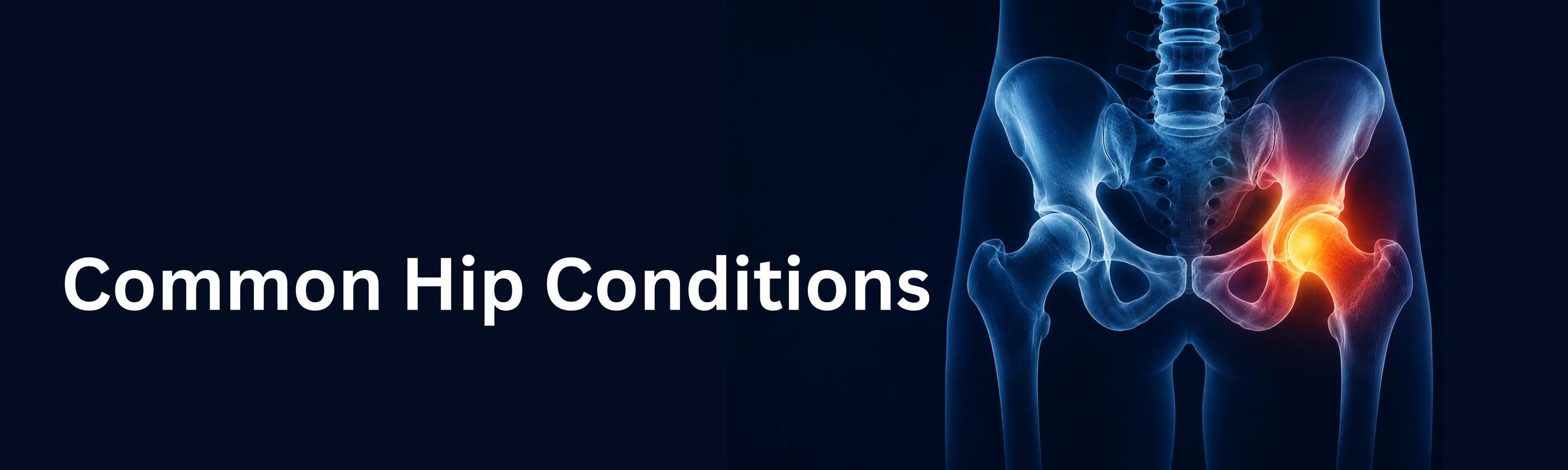
The most common reason for hip replacement surgery. Cartilage wears away over time, causing pain, stiffness and reduced mobility.
Hip Osteoarthritis
Extra bone on the ball or socket causes the bones to pinch during movement, leading to groin pain and often labral tears. Common in younger, active patients.
Hip Impingement
The labrum is a band of modified cartilage attached to the rim of the acetabulum (hip socket). Almost everyone who has an MRI scan will be diagnosed as having a labral tear, whether or not they have a hip problem. Significant labral tears invariably indicate an underlying mechanical issue in the hip such as impingement or microinstability.
Labral Tears
Hip Instability (Microinstability)
Excessive movement of the hip joint due to capsular laxity, sometimes following injury or in patients with generalized hypermobility.
Hip Surgery
Hip replacement surgery is performed to treat advanced arthritis and other conditions that have caused significant damage to the hip joint. During the operation, Dr Roberts will replace the damaged ball and socket of the hip are with artificial components designed to move smoothly and comfortably. The procedure aims to reduce pain, improve mobility, and help patients return to their normal daily activities with greater confidence and comfort. Dr Roberts has a tailored approach to each patients unique anatomy which he will go over with you during your consultation.
Hip Replacement Surgery
Hip arthroscopy is performed to treat mechanical causes of hip pain. While it cannot reverse damaged cartilage or arthritis, it can address conditions such as hip impingement (excess bone causing jamming), loose bodies within the joint, or a lax joint capsule causing microinstability.
These conditions commonly lead to labral tears, which Dr Roberts will assess and repair during surgery if required. Clinically significant labral tears rarely occur in isolation and are usually associated with underlying hip impingement or microinstability.
Hip Arthroscopy Surgery
Hip revision surgery is a procedure to replace part or all of a previous hip replacement that has worn out, become loose, become infected, or is no longer functioning as intended.
During the operation, some or all of the original implants are removed and replaced with new components. Revision surgery is generally more complex than a primary hip replacement and requires careful planning, as there may be bone loss or damage around the existing implants.
Common reasons for hip revision surgery include:
Implant loosening or wear
Recurrent hip dislocation or instability
Infection
Periprosthetic fracture (a fracture around the hip replacement)
Implant failure or persistent pain
The aim of revision surgery is to relieve pain, restore stability and function, and improve the longevity of the hip replacement.